Something changed last year regarding the retinol you find in stores, and most people have gotten it wrong.
You may have read that Europe has banned retinol. That is incorrect. Retinol is still permitted in cosmetics. What has happened is that as of November 1, 2025, there is a maximum limit, and the reason for that is not what almost everyone thinks.
What exactly has changed
Since November 1, 2025, a maximum limit for retinol and related forms has applied throughout the European Union in cosmetics: 0.05 percent in body lotion and 0.3 percent in face cream or serum.
In addition, there must be a warning on the label with this specific text:
Contains vitamin A. Consider your daily intake before use.
That sentence is not about your skin. It is about the total amount of vitamin A you consume through food, supplements, and what you apply, all added together. For the five percent of people with the highest intake, the upper limit can be exceeded through diet alone.
Products that were already on shelves before November 2025 may still be sold until May 1, 2027. That is why you still see them today without that warning.
What retinol requires of you
This is the part that rarely appears on packaging.
For the first few weeks, there is an adjustment period called retinization. According to dermatological literature, here is what you can expect: dryness or flaking, a burning or stinging sensation, and redness. How long this lasts has never been defined.
And then there is the patience. The best-designed study on retinol for skin aging lasted 24 weeks before fine wrinkles showed significant improvement. Realistically, count on 8 to 12 weeks before you notice anything in your texture, and about half a year for fine lines.
You must therefore get through a period of peeling, without knowing how long it will last, for a result that only arrives after months. Many people don't make it. Not out of impatience, but because they have to go to work every morning.
For whom retinol is not an option
This question is rarely asked, even though for a large group it is the only question that matters.
During pregnancy and breastfeeding. Topical retinoids are advised against as a precaution. If you are pregnant, trying to conceive, or breastfeeding, discuss with your doctor, gynecologist, or midwife what you should and should not use. We do not make statements about that on your behalf.
If your skin cannot tolerate it. This is the reason why bottles remain half-full in the cupboard.
If you do not want or cannot undergo that adjustment period. Anyone who deals with people every day doesn't always have room for weeks of peeling.
If you would rather not have a jar with an intake warning in your cupboard. That is a personal consideration and it is legitimate.
For all these people, the question is not what works the strongest. The question is what you can actually use.
The plant-based alternative, and what the research says
The best-known plant-based alternative is bakuchiol, from the plant Psoralea corylifolia, traditionally used in the Ayurvedic tradition.
In 2019, a randomized, double-blind study with 44 participants over twelve weeks was published in the British Journal of Dermatology, in which bakuchiol was compared to retinol.
For fine lines, both groups saw improvement.
Regarding tolerability, the bakuchiol group reported significantly less peeling and stinging at every measurement point.
That second result is what it's all about for many people. One study, with limitations, and so we are not claiming that bakuchiol does the same thing as retinol. But it was independently designed, and on the matter of tolerability, it clearly turned out in favor of the plant.
We have built a routine around that.
Our routine, and when to use what
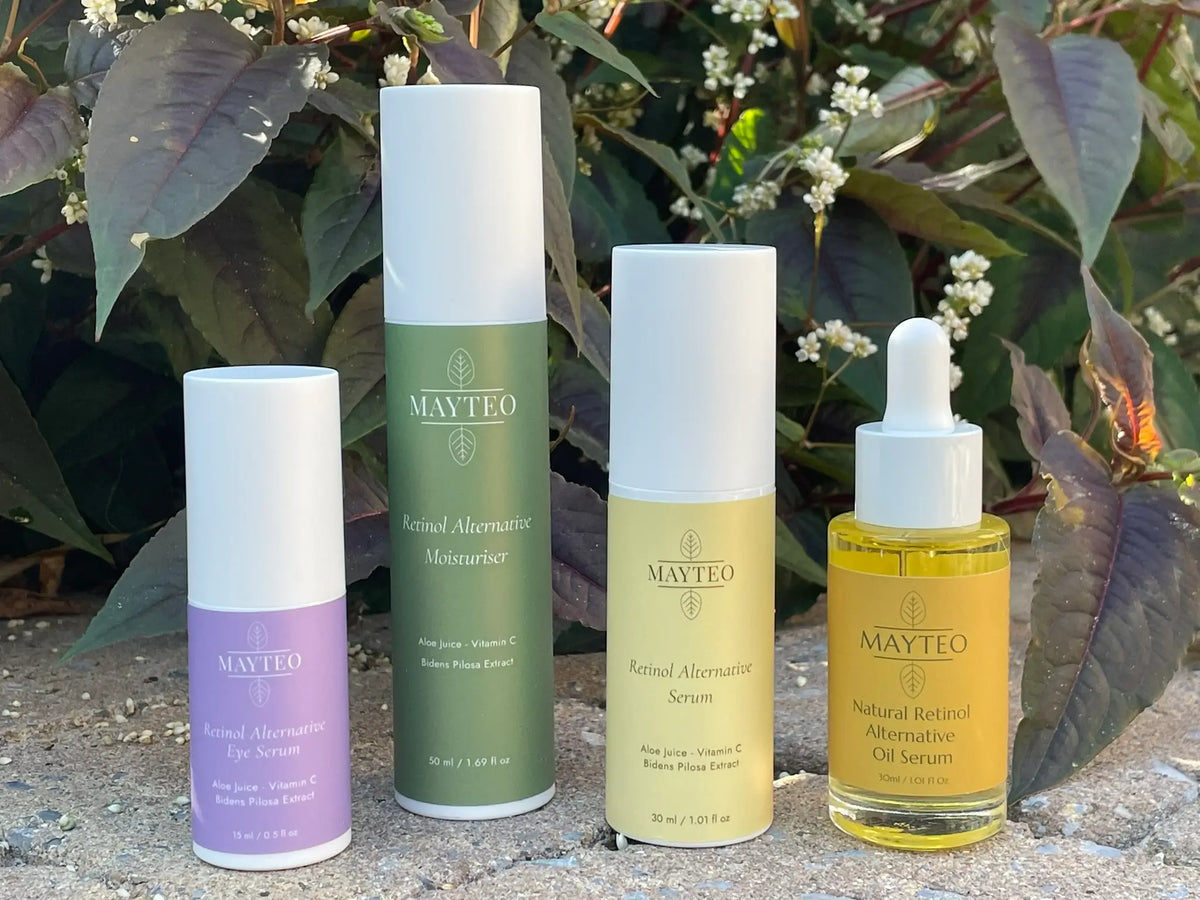
Four products, two plant-based ingredients, and no adjustment period whatsoever. There is no retinoid in them, so your skin doesn't have to get used to anything and there is no warning about your daily intake on the packaging.
The eye serum and the moisturizer are used twice a day. Only your serum changes: in the morning, the light water-based serum; in the evening, the oil serum. It doesn't get simpler than that.
| Product | Morning | Evening |
|---|---|---|
| Retinol Alternative Serum | ✓ | |
| Retinol Alternative Moisturiser | ✓ | ✓ |
| Retinol Alternative Eye Serum | ✓ | ✓ |
| Natural Retinol Alternative Oil Serum | ✓ |
Morning: Retinol Alternative Serum
30 ml, 28.90 euros
Light, water-based, absorbs quickly and disappears invisibly under your cream and SPF. With 2 percent Bidens pilosa extract, dual hyaluronic acid, and organic aloe vera juice as the first ingredient. ECOCERT COSMOS Natural, 99 percent of natural origin.
This is your morning step. Evening is fine too, but then it is better to use the oil serum.
Evening: Natural Retinol Alternative Oil Serum
30 ml, 34.90 euros
This contains the bakuchiol. An oil serum with jojoba, evening primrose, rosehip, and berry oils, and the richest product of the four. It is the only ECOCERT COSMOS Organic product instead of Natural, with 61 percent of organic origin compared to 22 to 24 percent for the other three. Also the only one dermatologically tested, which means its tolerability was checked under the supervision of a dermatologist.
Why in the evening? Because it is an oil. It can leave a slight sheen and has all night to slowly absorb. Daytime use is fine, and that applies to every oil we offer.
Day and evening: Retinol Alternative Moisturiser
50 ml, 24.90 euros
The same 2 percent Bidens pilosa, but as a light cream that finishes your routine. This is the product with which you replace your current day cream. With the lowest price of the four, it is also the logical starting point if you first want to try whether plant-based works for you.
Day and evening: Retinol Alternative Eye Serum
15 ml, 26.90 euros
The only product whose results you see immediately: a light-reflecting mineral pigment makes the eye area look more awake instantly. That immediate effect is optical and disappears with the product; the Bidens pilosa extract underneath works gradually. Works under makeup.
Please note: this is the only product of the four that is not nut-free, as it contains horse chestnut and castor oil.