You are standing in front of the shelf and there are thirty little jars. Bubble bath, shampoo, baby oil, a cream for the face and another for the body. Someone told you that you need all of this. That is not correct.
For healthy baby skin, you need three things. Washing, hair care, moisturizing. The rest is extra, and some of it is just sales.
This article explains why there are three, from what age you use what, and what is effectively on the labels in stores today.
Why baby skin asks for less, not more
A baby's skin is thinner than an adult's. The natural protective layer is not yet complete and will strengthen over the first few years. As a result, baby skin loses moisture more quickly, and it also reacts faster to what you put on it.
The temptation is to counter this with more products. The opposite works better. Every extra product is an extra list of ingredients on skin that is still learning. Fewer bottles that do their job are better than many bottles that each do a little.
The three things
A mild wash gel for the body
For what: the daily bath, on the entire body.
What matters is not how well something cleans, but how little it removes. A powerful cleanser rinses away the natural oils the skin needs along with the dirt. For an adult, that grows back; for a baby, it takes longer.
That is why you look for a wash gel based on mild cleansers, usually coconut-based, and not SLS. That you get less foam from it is not a deficiency, it is the result. Foam comes from strong detergents, not from cleanliness.
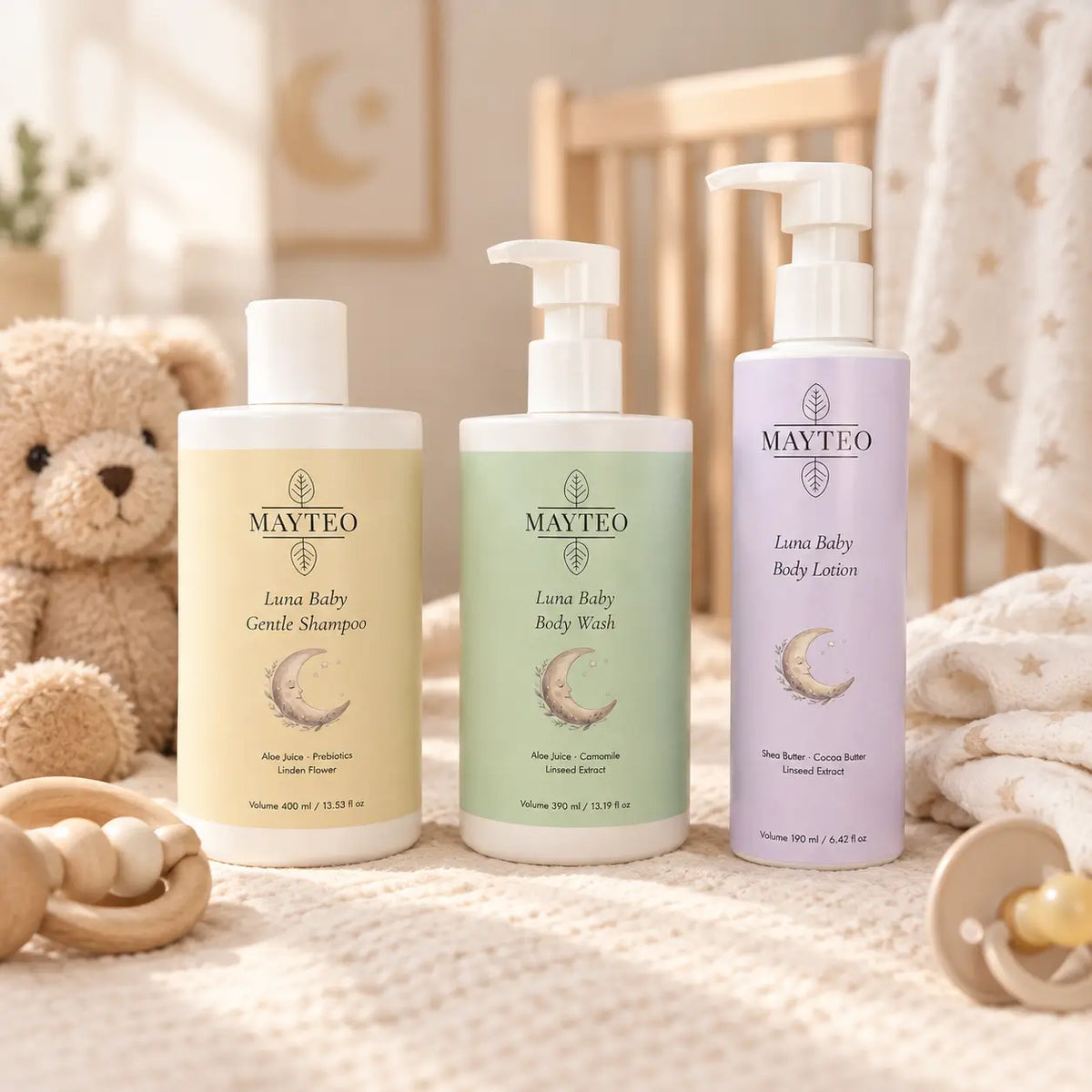
At Mayteo, that is the Luna Baby Body Wash, with organic chamomile and aloe vera juice, 98 percent ingredients of natural origin and ECOCERT COSMOS Organic certified. You can use it on damp skin or add a few drops to the bathwater.
A shampoo for the hair
For what: the hair and scalp, even if there is little hair yet.
The same applies here, with one difference. A baby's scalp is more sensitive than the rest and gets dry patches more quickly. A shampoo that degreases too powerfully makes that worse instead of better.
The Luna Baby Gentle Shampoo works without SLS and without aggressive sulfates, with organic aloe vera juice and linden blossom extract, and a prebiotic effect from a natural extract of red algae. A small amount is sufficient.
A lotion for after the bath
For what: the entire body, immediately after the bath.
This is the product where timing matters more than the formula. The skin retains the most moisture in the minutes after the bath. If you moisturize then, you lock that moisture in. If you do it an hour later, most of it has already evaporated and you are starting from a deficit.
The Luna Baby Body Lotion consists of 100 percent ingredients of natural origin, with cloudberry and linseed extract which are rich in omega fatty acids, and shea and cocoa butter that provide intense nourishment.
From what age can you use what
This is the question parents ask most often and which brands rarely answer per product. For our three, the answer is the same.
| Product | From | How often |
|---|---|---|
| Luna Baby Body Wash | the first day | daily is fine, in the bath or on damp skin |
| Luna Baby Gentle Shampoo | the first day | two to three times a week is usually enough |
| Luna Baby Body Lotion | the first day | daily, preferably immediately after the bath |
By the way, a newborn does not need a bath every day. Two to three times a week is enough for most babies, and in between, a washcloth on the areas that need it will suffice.
What you don't need
A separate face cream for healthy baby skin. A baby oil on top of a lotion. A separate product for every body part. A second shampoo for when the hair gets longer.
Those aren't bad products. They are products for situations you might never encounter. Buy them if you need them, not in advance.
What is on the labels today
We examined twenty-five baby products currently available in stores in Belgium and the Netherlands. Bubble bath, shampoo, wet wipes, diaper ointment, lotion, and sunscreen, from drugstore brands to brands that present themselves as natural. We won't mention any brands, because that is not the point.
What is striking first is what is no longer in them. Not a single product contained methylisothiazolinone. None contained SLS or SLES. None contained a formaldehyde releaser, talc, or the fragrance lilial. The nightmares that circulate online are largely no longer on the labels.
What is in them is fragrance. In nineteen of the twenty-five products.
And there is something there worth knowing.
Two words that mean less than you think
Hypoallergenic. According to the European guidelines on cosmetic claims, that word may only be used if the product is designed to minimize the allergen potential and if known sensitizers are avoided. Fragrance allergens are on that list. In our sample, at least one package stated the word hypoallergenic, while the same package listed two fragrance allergens in the mandatory allergen list. Both cannot be true.
That same guideline also states something else, in black and white: hypoallergenic provides no guarantee that an allergic reaction will not occur.
Dermatologically tested. That means the product has been tested on people under the supervision of a dermatologist. Nothing more. It says nothing about the outcome of that test. Not how many people participated, not what happened.
Approved is a snapshot in time
The argument you often hear is that everything on the shelf is permitted and therefore safe. The first part is true. The second part deserves a caveat, and that is in the history itself.
Lilial was a fragrance ingredient that was legally used in cosmetics for decades, including in products for babies. From 2005 onwards, it had to be listed by name on the label as one of the twenty-six fragrance allergens that must be disclosed. Since March 1, 2022, it has been completely banned.
Lyral, another fragrance substance from that same list of twenty-six, has been banned from new products since August 2019 and could no longer be sold since August 2021.
Methylisothiazolinone, a preservative, was allowed at up to one hundred parts per million in just about everything, including baby wipes. After a European wave of contact allergies, it was banned in February 2017 in every product that stays on the skin, and in 2018 the permitted level in rinse-off products was reduced by almost seven times.
The list itself is also growing. Those twenty-six fragrance allergens to be disclosed have become over eighty since this year. New products have had to comply with that expanded list since the end of July 2026, and products that were already there can still be sold until July 2028. This means that for the next two years, there will be jars in stores with a label that does not yet follow the new rule. That is not a violation, that is the transition period.
The same pattern can be seen with sun filters. A filter that was allowed up to ten percent in all products until last year may only be used in face products and up to 7.34 percent since January 2025. Another has been completely banned since this year.
This is not an indictment of the regulations. They do their job, and they do it based on scientific advice. But it does show what an approval is: the best estimate of today, with the knowledge of today. Sometimes that is revised.
We prefer not to wait for that revision. That is why we choose formulas that are checked by an independent body for their full composition, the origin of the raw materials, and the production process, not just for what is on the front of the box. That is what ECOCERT COSMOS certification does, and that is something you can check yourself.
And our own products
In writing this, we must also be honest about ourselves.
Our three Luna Baby products contain fragrance. A mild natural fragrance, and it is in the ingredient list. The Body Lotion also contains vanillin, a substance that is on the extended allergen list and is therefore listed by name. If your child has a highly reactive skin, test it first on a small patch of skin. That advice is also on every product page.
The full ingredient list of every product is written out in full on the product page. Not in a drop-down menu at the bottom, just on the page. You have the right to know what you are putting on your child's skin.
In summary
Three products are enough for healthy baby skin. Wash gently, don't wash too often, and moisturize at the moment it counts.
When choosing, don't look at the words on the front, but at the list on the back. And if a brand makes a claim, feel free to ask what it is based on.